
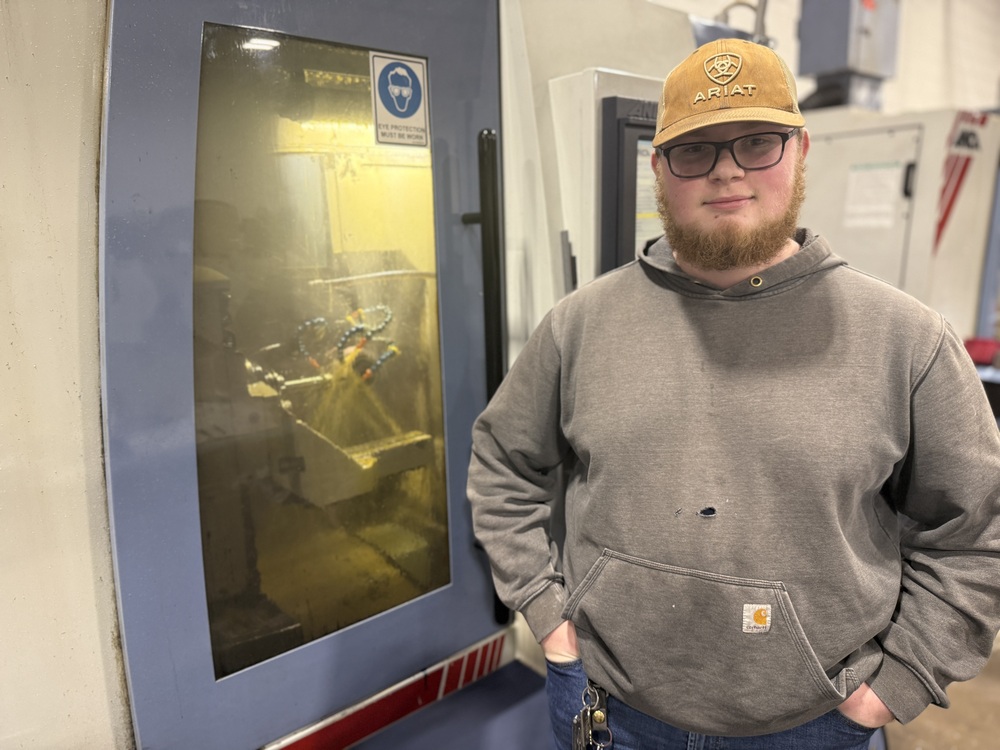
For Sean Laudenslager, a student in Precision and Computerized Machining Technology (PCMT) and Boyertown senior, the path to his future career began with a simple but powerful interest: making things.
“I’ve always thought making things was cool,” he said. “But making things that are really precise—and understanding how they’re made—that’s what really got me hooked.”
That curiosity led Sean to attend an open house at BCTC, where he first explored the machining program. Originally enrolled in IT Networking, he quickly realized it wasn’t the right fit. After making the switch to PCMT, everything clicked. “It was just more my thing,” he said. “I like this a lot more.”
In just about a year and a half, Sean has accelerated through the program, mastering both foundational and advanced skills. He has already completed all his manual NIMS (National Institute for Metalworking Skills) projects. Those projects include pieces like step blocks, milled components, and precision-ground parts with tight tolerances. Grinding has become a standout skill for Sean. “That’s a lot more like what I do at work,” he said. “Toolmaking is what I specifically do.”
Sean has developed a strong understanding of both manual machining and CNC (computer numerical control) programming. While programming presented a learning curve, he says it becomes manageable once you understand the logic behind it. “You’ve got to think through everything,” he explained. “There are a lot of small details you need to remember, but once it clicks, it makes sense.”
A key aspect of machining is measurement—and Sean has gained hands-on experience with advanced tools in BCTC’s metrology lab. One tool he uses regularly is an optical comparator, which projects a magnified shadow of a part onto a screen for precise inspection. “It doesn’t show the actual part, just the outline,” he explained. “But it makes it huge, so you can measure it really accurately.”
Understanding measurement, tolerances, and inspection has directly translated to his work environment, where precision is critical. Sean’s co-op placement is at On the Spot, a tool-and-die shop, where he is already applying his classroom knowledge in a professional setting. “There’s always a print to read,” he said. “Print reading is a huge part of the job, and that’s something we really learn here.”
At work, Sean helps create specialized tools used to manufacture parts—often custom, one-off pieces that require both creativity and technical skill. He’s also learned about advanced tooling techniques, including brazed tools, which combine a steel body with carbide cutting edges. “It makes things more cost-effective,” he explained. “Instead of replacing the whole tool, you can just replace the carbide and reuse the body.”
Sean’s experience has also taught him how to adapt. Not all prints are straightforward—some are even hand-drawn—and machinists often need to interpret incomplete or unclear instructions. “Sometimes you have to ask questions or even call the customer,” he said. “You need to understand what the tool is being used for so you can make it right.”
Though machining is a broad field, Sean has begun to identify his niche in toolmaking specialized area focused on producing the tools that shape other parts. “It’s kind of a niche, but I like it,” he said.
Looking ahead, Sean is considering further training, possibly at the Automotive Training Center, where he could apply his machining skills to engine work—another long-standing interest. “I’ve always liked cars,” he said. “That might be something I want to focus on.”
For students unsure about their future, Sean offers simple but practical advice: explore. “Open houses are the best way to see what a program is really about,” he said. “You can come in, see the shop, talk to people. That’s what helped me.” He also recommends shadowing programs and exploring related fields like mechatronics or drafting for students interested in engineering and manufacturing.
Sean credits BCTC with giving him the skills and confidence to succeed in his co-op and beyond. “It’s helped 100 percent,” he said. “When you understand how things are made and how they’re used, it makes everything easier.”
As he prepares to graduate, Sean is already ahead of the curve—armed with technical knowledge, real-world experience, and a clear direction for the future. For him, precision machining isn’t just a class, it’s a craft he’s ready to build a career on.