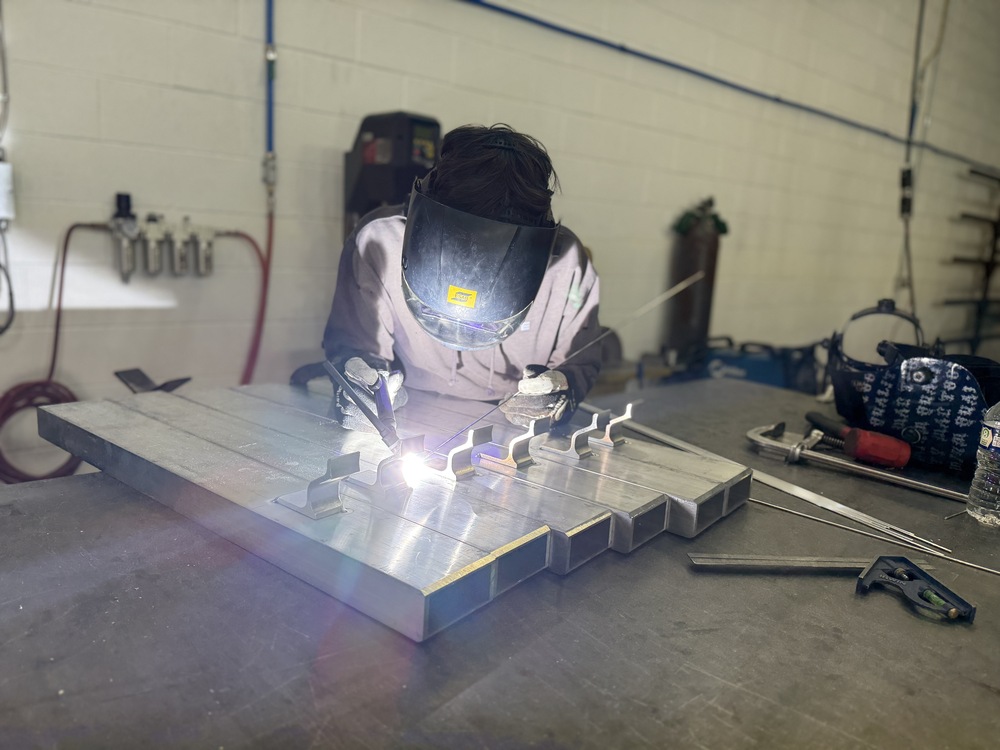
For senior Linkoln Frymoyer, welding isn’t just a class, it’s already a career in motion. The Exeter student is gaining real-world experience through a co-op placement at Board Safe Docks, where he helps fabricate aluminum docks and gangways designed for both functionality and accessibility.
At Board Safe Docks, Linkoln works primarily in Shop C, where smaller components are measured, cut, and welded before being sent to another shop for full assembly. From crossmembers to railings, he contributes to nearly every stage of the process. “We pretty much weld every part,” he explained. “Then it all comes together into docks and gangways.”
What makes the company’s work especially meaningful is its focus on accessibility. Many of the docks Linkoln helps build are designed to accommodate individuals with disabilities. These specialized structures allow wheelchair users to safely access the water, often featuring transfer benches and kayak launch systems that prevent tipping and improve stability. “It’s really cool to know what we’re building helps people who otherwise might not be able to get out on the water,” Linkoln said.
The company also has a unique reach beyond Pennsylvania. Board Safe Docks holds a contract with the state of Tennessee, making it the exclusive builder of docks for its national parks. As a result, much of Linkoln’s work contributes to projects that will eventually be installed hundreds of miles away.
Each day on the job brings new challenges. Linkoln is constantly refining his skills, particularly when it comes to welding aluminum, a material he hadn’t worked with extensively before his co-op experience. “I’m still learning new things every day,” he said. “Sometimes I’d be nervous to weld a final piece because I didn’t want to mess it up, but now I’m getting more comfortable.”
Welding, he explained, requires a balance of precision and adaptability. Different materials require different techniques, temperatures, and settings. Thinner materials can be especially tricky, as too much heat can create holes that must be carefully repaired. Thicker materials, on the other hand, demand proper penetration to ensure structural integrity. “Right in the middle is probably the easiest,” Linkoln said. “If it’s too thin, you can blow through it, and that’s harder to fix. If it’s too thick, you must fine-tune everything to make sure it’s strong enough.”
Beyond technical skill, Linkoln has also learned the importance of teamwork. At Board Safe Docks, welders, drafters, and cutters work closely together, creating what he describes as a “small family.” When issues arise—such as a missing detail in a blueprint—communication between departments is immediate and collaborative. “They want you to speak up and fix things right away,” he said. “Everyone works together.”
Linkoln’s interest in welding began years earlier when he started exploring career options in middle school. Intrigued by the earning potential and fascinated by specialized fields like underwater welding, he pursued opportunities to learn the trade. A metal shop class introduced him to the basics, and eventually, he enrolled in a career and technical education program despite initially being placed on a waiting list. “I almost didn’t get in,” he recalled. “But a spot opened up, and I took it right away.”
That decision has paid off. While his school program helped him build a strong foundation in welding fundamentals like fit-up and consistency, his co-op has expanded his skill set even further. Working with aluminum MIG welding has given him hands-on experience in a fast-paced, production environment. “Fit-up is just as important as the weld,” Frymoyer emphasized. “If your measurements are off, it doesn’t matter how good your weld looks—it won’t fit.”
Looking ahead, Linkoln already has a clear next step. He has been offered a full-time position with Board Safe Docks after graduation, along with a pay increase. For now, he plans to continue working while exploring long-term goals within the industry.
“I might want to move into a management role someday,” he said. “Welding is tough on your body, so it’d be nice to stay in the field but not always be the one doing the welding.” In addition to his work at the company, Linkoln also runs a small side business detailing cars, demonstrating his strong work ethic and entrepreneurial spirit.
As he prepares to graduate, Linkoln has simple but meaningful advice for younger students considering a similar path: “Don’t let other people decide what you want to do. Stick with what interests you.”
With hands-on experience, a full-time job already secured, and a clear vision for the future, Linkoln is proving that skilled trades offer not just opportunity—but a solid foundation for long-term success.